

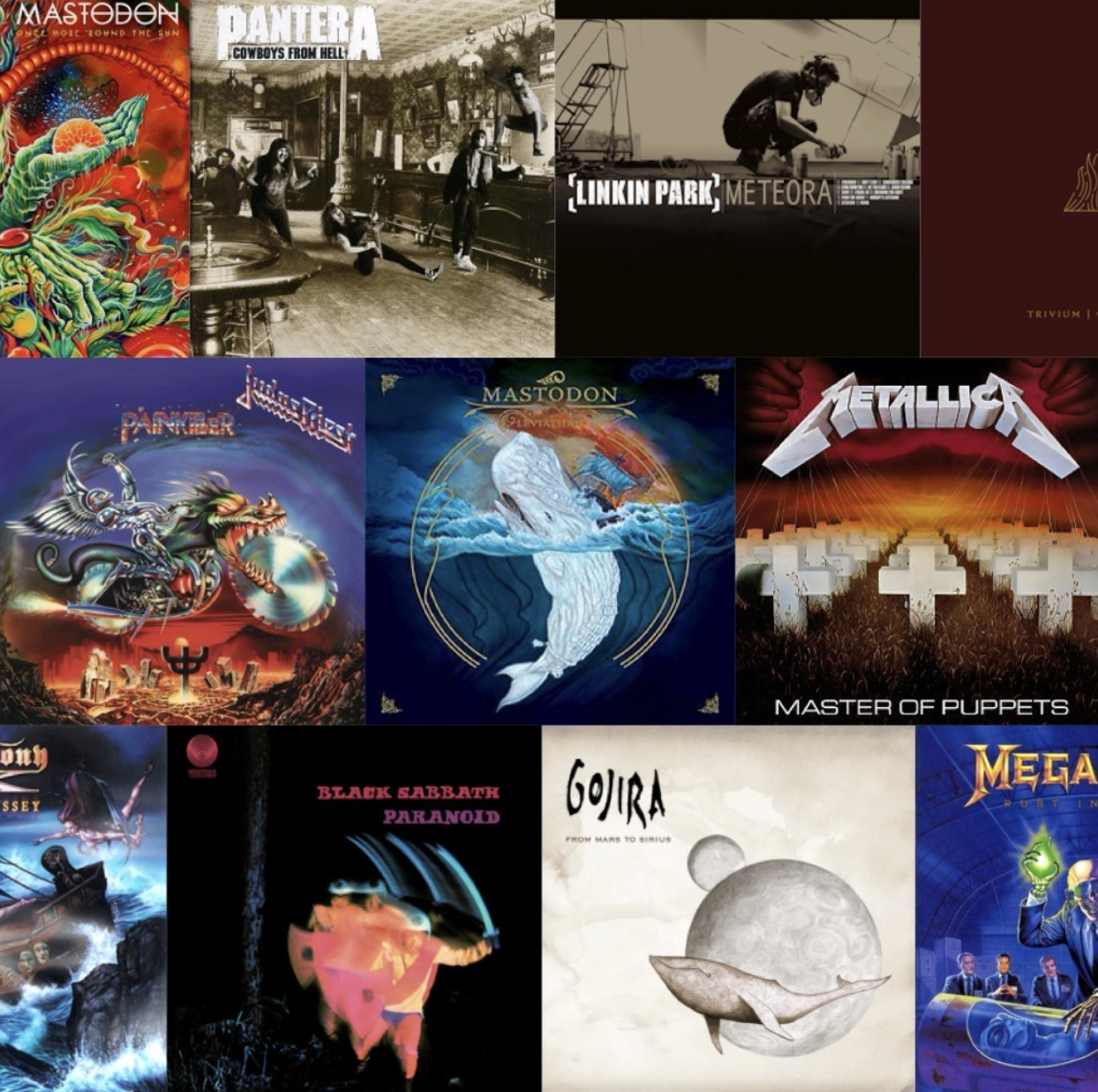

My first experience with metal was eight years ago when an acquaintance recommended I listen to the track “One” by Metallica during class. I did, and was instantly enraptured. The sound was unlike anything I’d ever heard. Metal is an endlessly complex genre of music pioneered by Black Sabbath in the 1970s with records such as “Black Sabbath,” “Paranoid” and “Master of Reality.” Metal has branched out heavily in the 50 years since its inception, with numerous subgenres appearing in its wake. The subgenres range from fast and complex thrash metal to lengthy and experimental progressive metal, or aptly named extreme metal to brutally heavy death metal and everything in between.
It is to be expected that this wide range of subgenres possess their own unique style of metal. Thus beginners can have immense difficulty in finding out where to start listening to the genre. Metal can, however, be broken down into levels of sorts, each becoming progressively heavier and more complex.
Level One: Introductory
The first level of metal music is introductory metal, demonstrated perfectly by the record “Meteora” by Linkin Park. “Meteora” is a relic from the peak of the nü-metal genre in the early 2000s. Nu metal was pioneered in the 1990s by bands such as Korn, Limp Bizkit and Slipknot and peaked in terms of both popularity and quality with Linkin Park’s first two records, “Hybrid Theory” and “Meteora,” released in 2000 and 2003 respectively.
“Meteora” contains the hallmarks of its subgenre: shorter songwriting almost completely devoid of solos, elements of electronic music rather than the traditional instruments of a metal band, although all of those instruments are still present, and a vocal style with elements of rapping,screaming and growling.
Although almost every track on “Meteora” is legendary in its own right, three standout tracks are “Faint,” “Figure.09” and “Numb.” “Faint” begins with its instantly recognizable electronic beat, which dominates the instrumental portion of the song. Percussion and guitar only enter around the chorus. As with almost every Linkin Park track of the time, the talent of rapping vocalist Mike Shinoda is elegantly mixed with the voice of lead vocalist Chester Bennington.
“Figure.09” trades the electronic sound of “Faint” for guitar-led instrumental more reminiscent of traditional metal.
“Numb” is a deeply emotional ballad with electronic beats intermixing perfectly with guitar riffs and percussion for the entirety of the track similarly to the harmonizing of Shinoda’s backing and Bennington’s lead vocals, which together create an unforgettable sound.
Level Two: Standard
The second level is standard metal, where the record “Painkiller” by Judas Priest is a perfect example. The musical style of “Painkiller” is a perfect evolution of the first metal played by Black Sabbath, with evolution brought on by changing musical capabilities. The album was released in 1990 along with other legendary metal records such as “Rust in Peace” by Megadeth and “Cowboys From Hell” by Pantera.
The standout tracks of “Painkiller” are the titular track “Painkiller,” “Metal Meltdown,” and “One Shot at Glory.” “Painkiller” opens with its signature aggressive drums which are shortly joined by guitar and vocals, telling the story of the painkiller, a mechanical avenging angel who has come to save mankind from its devastation.
The complexity of “Metal Meltdown” is on full display from the instant the track opens with its masterfully technical guitar play, and although drums and vocals also make up a large part of the song, the guitar remains the most memorable part of the track.
“One Shot at Glory” is a glorious anthem of courage and heroism, completed by inspiring vocal delivery and energizing instrumental.
Level Three: Experimental
The third level is experimental metal, and with it comes “Leviathan” by Mastodon. “Leviathan” is a concept album which melds the story and literary themes of “Moby-Dick” by Herman Melville with the monstrous riffs of Mastodon. Mastodon blends the quas-classical complexity of progressive metal with the slower downtuned riffs of the sludge metal subgenre to create a sound that is almost wholly unique, and “Leviathan” is their masterpiece.
Each one of the record’s tracks is a beautiful composition of its own, as goes with all of Mastodon’s work, but the best of the best are “Blood and Thunder,” “Naked Burn” and “Hearts Alive.”
In “Blood and Thunder” the commands of Captain Ahab to his crew as they hunt the white whale who is Ahab’s “holy grail” make up the majority of the lyrics, with the riffs of guitarists Brent Hinds and Bill Kelliher completely dominating the instrumental.
“Naked Burn” is in my opinion the greatest metal track of all time. The chugging riff is a wondrous demonstration of Mastodon’s prowess, and the protracted cries of “save yourself, don’t wait on me” which are barely audible beneath the guitar are quite simply haunting. One must listen to this track to truly understand its beauty.
“Hearts Alive” is the nearly 14 minute penultimate track of “Leviathan,” composed of mostly instrumental passages. The song is an unforgettable testament to Mastodon’s ability not only to craft beautifully technical music, but also to impart complex themes and stories through that music.
Level Four: Intricate
The fourth level includes some of the most complex and heaviest subgenres and albums metal has to offer, including “From Mars to Sirius” by the French band Gojira. “From Mars to Sirius” is a record of the technical death metal genre, or tech death, for short, which is a subgenre of death metal which focuses on instrumental and songwriting complexity.
The three greatest tracks on “From Mars to Sirius” are “Ocean Planet,” “The Heaviest Matter of the Universe” and “Flying Whales.” “Ocean Planet” features a short but technical guitar riff, which repeats for most of the track, sometimes accompanied by vocals and always followed by a moment of respite. This riff is quite enchanting and is alone enough to make a more than memorable track, despite amazing vocals and drumming.
“The Heaviest Matter of the Universe” is an aggressive joyride, never slowing down and never giving the listener a moment to catch their breath, and is all the better for it. Unlike other tracks, which are dominated by one aspect, the vocals, guitar and drums all perfectly balance one another out, creating a listening experience to remember.
“Flying Whales” showcases the intermixing of slow, almost melancholic instrumental passages with the aggressive weight of tech death music, taking the listener on a journey for the duration of the almost eight minute track.
From the simplest nü-metal track to the most complex progressive metal, there is a beauty that can be found in metal and nowhere else, and if I’ve managed to impart even a fraction of this beauty on my readers, then I’ve done my job well.
