
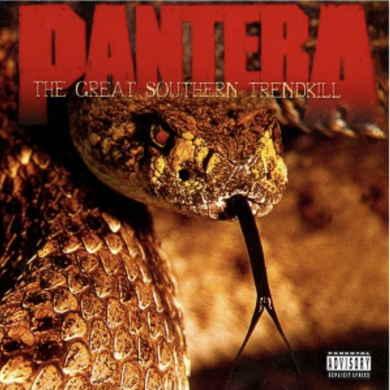

It is a recurring theme in metal that bands must reduce the weight of their sound to fit the contours of the mainstream. The inverse, however, is a rare phenomenon. Rare, but not unheard of. Enter Pantera, easily one of the greatest metal outfits of the 90s. Pantera began as the brainchild of brothers Darrell Abbott, known professionally as Dimebag Darrell, and Vinnie Paul Abbott in 1981. Pantera’s earliest era was defined by the dominant sound of the 80s: glam metal.
The band’s final full and best known lineup was Phil Anselmo on vocals, Dimebag Darrell on guitar, Rex Brown on bass guitar and Vinnie Paul on drums.
Pantera released four records with this style throughout the early to mid 80s, none of which would be met with any notable success. And in a turn of events, Pantera would abandon their roots, nearly wiping the world of all traces of them. In 1990, Pantera released their true debut album, “Cowboys From Hell.”
Pantera were trailblazers, pioneering the groove metal sound which defined their entire later career. Groove metal is a subgenre defined by its slower, repetition-focused and groove-focused riffs, encompassing traits of thrash, traditional metal and extreme metal, especially in the vocal performances of groove tracks.
Following the success of the groundbreaking “Cowboys From Hell,” Pantera released “Vulgar Display of Power” in 1992, to even greater acclaim than their previous record. Against all odds, with their third record, “Far Beyond Driven,” Pantera not only achieved their first Billboard number one album, but also crafted the heaviest and most extreme record to hold this position. On top of this, they did so at the height of grunge, an alternative rock subgenre defined by highly distorted guitars and introspective lyrics which dominated the mainstream in the mid 1990s.
Even in the midst of band tensions coming from Anselmo’s use of alcohol and hard drugs, Pantera recorded a fourth record, with Anselmo recording his pieces separately from the rest of the band in Trent Reznor of Nine Inch Nails’ studio. This record was “The Great Southern Trendkill,” the magnum opus of Pantera and one of the greatest albums of all time.
“The Great Southern Trendkill” was far more raw and extreme than any of Pantera’s previous releases, melding elements of death metal, grindcore and other extreme metal subgenres with their original groove metal sound. Not only this, but “The Great Southern Trendkill” features tracks of slow, downtuned doom metal and a country-reminiscent song led by Dimebag Darrell playing a 12-string acoustic guitar.
A great deal of this record’s quality comes from its sonic variance. It delivers on everything expected from a Pantera record while also exploring new territories which showcase not yet seen facets of the band’s skillset.
Every element of “The Great Southern Trendkill” comes together perfectly to take the listener on a journey through rage-fueled, spiteful death metal; hypnotic doom metal; mournful acoustic ballads; erratic, violent grindcore; classic groove metal and immaculate traditional metal masterpieces.
The record opens with its titular track, “The Great Southern Trendkill,” which rages against the vapid materialism and trend-chasing of society. This commentary has only become more relevant in the thirty years since the record’s release. The lyrics describe how people will sacrifice anything to follow the newest trend, hence, “if Hell was ‘in,’ you’d give your soul.”
“The Great Southern Trendkill” is overall a more classic groove metal track. Instrumentally speaking, it displays a relatively traditional riff, just harsher vocals than much of Pantera’s previous work. And in keeping with nearly the entirety of the band’s discography, the track ends with a Dimebag Darrell solo.
“War Nerve” is one of the more death metal influenced tracks, with its aggressive vocals and instrumentals. Expletive-laden lyrics convey an animosity towards the world. The track is easily one of the most raw and aggressive of the record.
“Drag the Waters” is the third track of the record, and interestingly, the only track from “The Great Southern Trendkill” to be included on Pantera’s best of release. “Drag the Waters” is one of the track’s most similar to Pantera’s prior releases, with a consistent grooving riff and clean vocals, while the lyrics discuss “dragging the waters,” a metaphor for the difficult search for the truth.
An immediately notable track, “10’s” entirely sheds any resemblance to groove metal, instead favoring the low, slow, crushing riffs of doom metal. Not only is the solo significantly slower paced than the vast majority of its counterparts, it is also preceded by an acoustic interlude, which is rarely seen in Pantera tracks. The out-of-the-ordinary instrumental combined with Anselmo’s hypnotic vocals make “10’s” a clear standout of the record.
“13 Steps to Nowhere” is one of the less memorable tracks of “The Great Southern Trendkill.” Although far from bad, the song never had as much that made it stand out, hence the lack of any significant analysis.
“Suicide Note” is Anselmo’s two-part lamentation of his crippling heroin addiction, telling a story mirroring his own. Part one begins with a haunting keyboard opening which transitions into a relatively simple but enthralling piece played on a 12-string acoustic guitar while the lyrics describe a man, heavily implied to be a stand-in for Anselmo, and his struggles with cocaine addiction, eventually leading him to attempt suicide by slitting his wrists. However, the man survives and resolves to “try to live through this night.”
The second part of the track begins by giving the listener sonic whiplash, having changed from an acoustic ballad into an erratic piece of grindcore — one of, if not the most extreme sub genres of metal music — where the man has succeeded in suicide, with a “gun up to the mouth / no pretension, execution.” With a sense of finality, the man states, “this is for me / and me only, cowards only try it / don’t you try to die / like me.”
“Living Through Me (Hell’s Wrath)” is yet another death metal-influenced track and, like other tracks found later in the records runtime, it features a nearly silent interlude which separates the aggressive punch of the track into sections, giving the listener some valuable breathing room while the track blazes along like a runaway steam engine.
The magnum opus of Pantera’s magnum opus is without a doubt the ninth track, “Floods.” The track opens with an instantly crushing, atmospheric guitar piece which segues into the first half of the song, where all the lyrics are contained. The moment Anselmo says, “a dead issue / don’t wrestle with it,” the tone of the six minutes to come is cemented.
With an infinitely ominous echo, Anselmo tells the story of mankind’s limitless sin. Describing how “then throughout the night / they were raped and executed … coldhearted world” and “then throughout the day / mankind played with the grenades … coldhearted world / and at night, they might bait the pentagram … extinguishing the sun.”
And yet, even in the face of man’s sin, those who could stand for the good of the world do not. Hence: “deaf ears are sleeping / a guilty bliss / so inviting (let me in)” and “your language unheard of / the vast sound of tuning out.” Thus, in the face of the righteouses’ apathy towards sin, God exercises his power, deciding to “wash away man, take him with the flood” in a crushing yet doubtlessly beautiful pair of bridges and guitar solo that feels as if the floods of sin and retribution are falling upon you through the song.
And finally, with all man’s evil, cruelty and malice washed away, the track ends with one final, elegant solo, then silence.
“The Underground in America” contains the death metal traits of other tracks yet not the respite, creating one of if not the most crushing and heavy track crafted by Pantera’s hands. For that, “The Underground in America” deserves applause.
The themes of “The Great Southern Trendkill’s” titular track are carried on by its counterpart “(Reprise) Sandblasted Skin,” the record’s final track. Though it’s similar in style to its predecessor, the track is a bit heavier and nearly two minutes longer. However, most of that added time is silence, as the lyrics and instrumental of the song end a bit over three minutes into the song, leading to about a minute and a half of silence before the instruments enter once again for a final breakdown, ending the magnum opus of one of the greatest metal bands to ever play.
Thirty years after its release, I give it a ten out of ten.
