

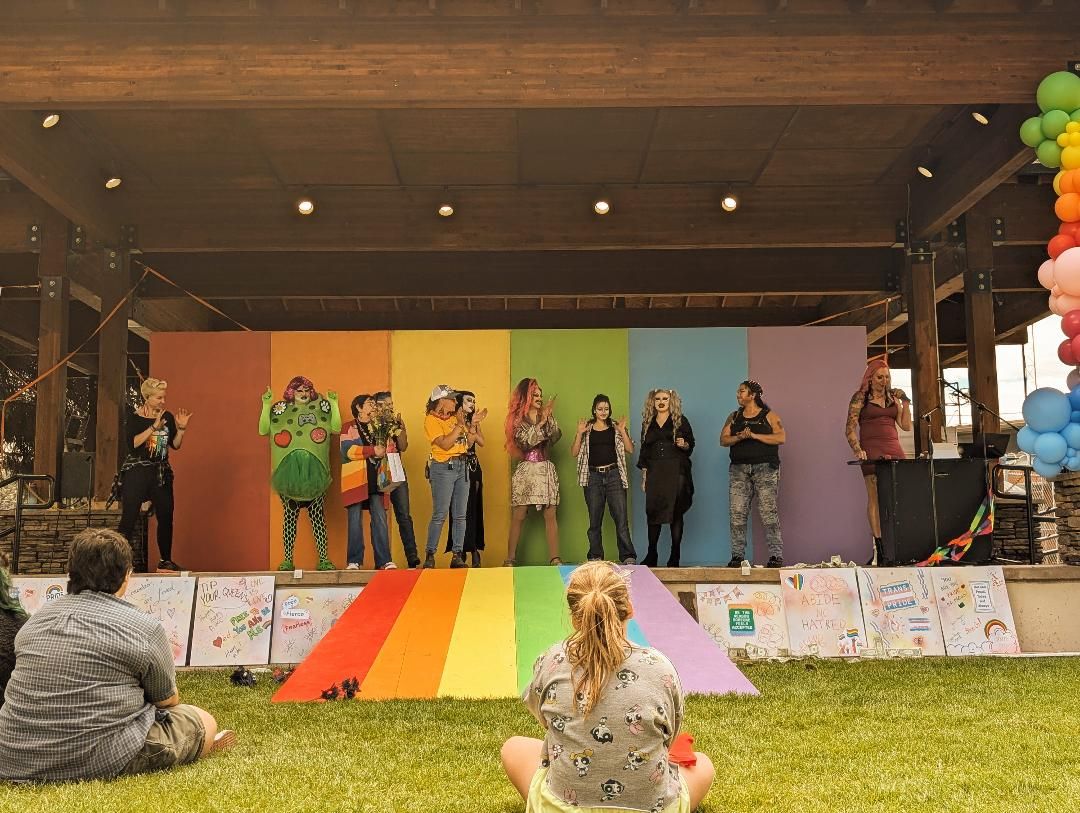

The annual Prideville festival celebrated its sixth anniversary on Sunday, June 28, featuring performances, vendors and community booths in Prineville’s Pioneer Park. Drawing a crowd of around 600 people despite unseasonably cool weather, Prideville Board President Alia Fern considered the event a success and an important step towards bringing queer visibility to rural Central Oregon.
The festival’s initial seeds were sown in 2020 following heated Black Lives Matter protests in Prineville. Fern and her fellow organizers wanted to provide a counter-narrative to the unfolding conflict and provide a space for the queer community and other marginalized groups to find belonging in Prineville. With only two weeks to plan the march, the group shored up local support and drew a turnout of 42 people and three dogs, according to Fern.
“That was kind of our first go at queer activism in Prineville,” she explained.
The next year, in 2021, the march blossomed into the inaugural Prideville festival, which has been held every year since and grown significantly from its humble roots.
While not the only pride event in the region — Bend’s annual celebration occurred on June 6 — attendees reported that Prideville felt more community-oriented and welcoming.
Additionally, Fern said that this year, the event’s organizing board strived to make Prideville more engaging for attendees. This goal shaped many of the activities offered at the festival, including a free photo booth operated by community sponsor FotoHue, an interactive aerial silks exhibition and opportunities to play lawn games with drag performers.
So what makes the event so special? According to organizers and attendees, the answer lies in Prideville’s rural identity, reflected in the festival’s 2026 theme: “Small town, big pride.”
Prineville, a Central Oregon community of approximately 12,000 people, is a very different environment from larger neighbors like Bend. However, according to Fern, the town’s smaller population doesn’t indicate a lack of interest in events such as Prideville. After all, according to a 2019 report, between 2.9 million and 3.8 million queer Americans reside in rural areas, making up 15 to 20% of the country’s total LGBTQ+ population.
In light of recent political and legal developments — gender-affirming care restrictions, an executive order delegitimizing transgender identities and Supreme Court rulings upholding bans on transgender athletic participation and overturning a law prohibiting conversion therapy — attendees said that pride feels more important now than ever.
“We’re living in an exceptionally dangerous time,” said Dylan S. Levi, a Prineville resident and recent graduate of Redmond Proficiency Academy (RPA). “We’re ten years from the legalization of gay marriage and it’s still such an exceptionally uphill battle.”
But to Levi, Prideville is a reminder that “we’ll always keep fighting for each other, regardless of the circumstances, regardless of how uphill of a battle it seems.”
Fern agreed, emphasizing the importance of the event for queer youth, who are among the nation’s most vulnerable demographic groups. As a mental health therapist working in Prineville, she has witnessed firsthand the struggles faced by the area’s young queer population, and expressed hope that Prideville would help them find connection.
“It’s about the young people,” Fern said. “We want them to have a party.”
According to young Prineville residents Allen Cochran, Kristen Bucholz and Willow Stockton, Fern and her fellow Prideville organizers achieved her goal. All three enjoyed the social aspect of the festival, the vendors and the opportunity to meet new people with shared experiences and values.
“It’s refreshing to have at least a day of being yourself,” said Cochran, a Crook County High School student. Beyond fun with friends, he noted that Prideville felt like a safe space for self-expression.
“I’d never go to school like this,” he said, gesturing to his outfit and bracelet-stacked wrists. “Well, I have before but I don’t know that I want to again.”
Alaska Waters, a musical performer at Prideville and recent RPA graduate, echoed similar sentiments. While they often perform in restaurants around Central Oregon, they said that Prideville provided an opportunity to share more personal music related to their queer identity.
“It’s very nice to be able to come to a place like this and play very openly queer music that’s a little bit raunchier than I would normally bring to other gigs that I do,” Waters explained.
While Fern was largely satisfied with the turnout, she remains dedicated to growing the event further and fostering broader community involvement across Central Oregon. By growing Prideville’s organizing board and inviting non-members to volunteer and participate, she hopes to both expand the festival and bring new events to the community throughout the year.
“I think there’s a lot of ripe opportunities that we can develop,” Fern said.
In the meantime, Fern hopes that Prideville’s 2026 iteration sent a clear message to the queer community in Prineville and other rural areas across Central Oregon and beyond.
“We do exist here. We do belong here,” she emphasized.
